


Journals
Laser Photochemistry Laboratory

Journals
Laser Photochemistry Laboratory
Abstract
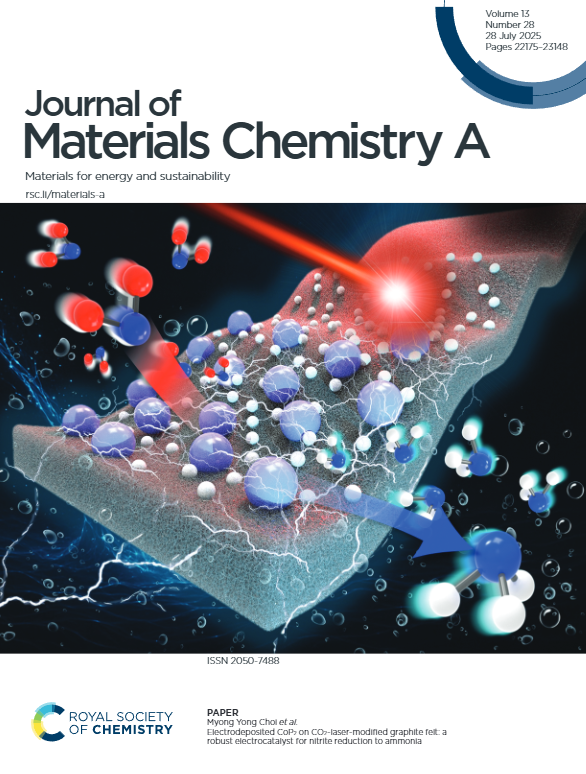
The conversion of nitrite-based pollutants to value-added ammonia (NH3) via sustainable electrocatalysis represents a remarkable advancement in waste management research. Herein, a two-step strategy was developed to synthesize well-dispersed cobalt phosphide (CoP2) on graphene oxide (GO)–graphite felt (GF), termed CoP2/GO–GF. The electrodeposited CoP2 exhibited exceptional performance in electrocatalytic NO2⁻ to NH3 reduction reaction (NO2RR), achieving a maximum NH3 yield rate of 10.6 mg h⁻1 cm⁻2 with a Faradaic efficiency of 80% at −0.4 V vs. reversible hydrogen electrode (RHE). The high efficiency of CoP2/GO–GF is attributed to its improved surface-active site density, enhanced electrochemical double-layer capacitance (3.37 mF cm⁻2), and optimized electron transfer resistance (13.31 Ω). Furthermore, a turnover frequency analysis of NO2RR indicated the abundance of active sites, facilitating smooth charge tunneling from CoP2 to CO2 laser-developed GO on GF in CoP2/GO–GF. In-situ FTIR analysis confirmed the sequential reduction pathway from NO2⁻ to NH4⁺, with identifying NO as a key intermediate. Additionally, density functional theory (DFT) calculations revealed a moderate free energy barrier (0.26 eV) for the rate-limiting step, thus validating the thermodynamic feasibility of the reaction. Furthermore, durability tests demonstrated stable performance over 10 reuse cycles, thereby demonstrating the efficiency and robustness of CoP2/GO–GF as an electrocatalyst in NO2RR.
https://www.lecturernews.com/news/articleView.html?idxno=183704
https://www.shinailbo.co.kr/news/articleView.html?idxno=2093002